Description
Applications:
|
|
Features:
|
|
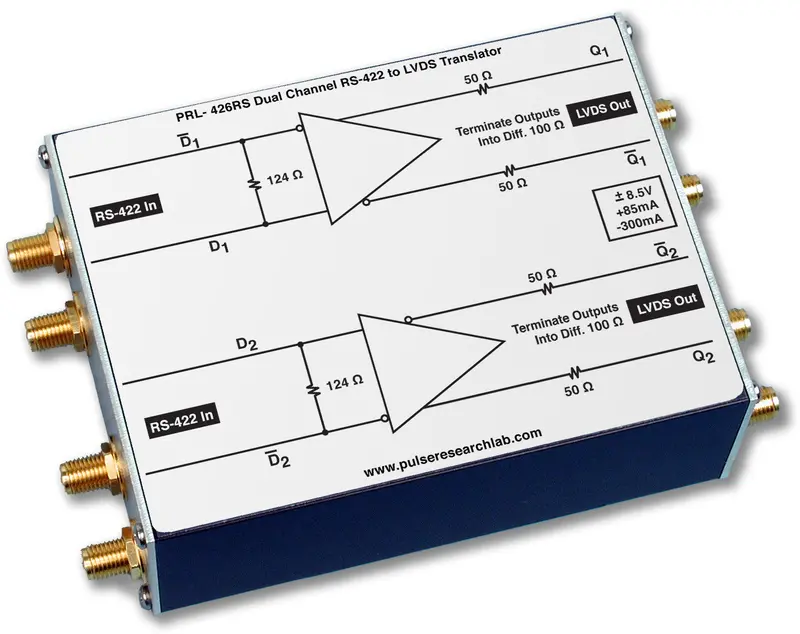
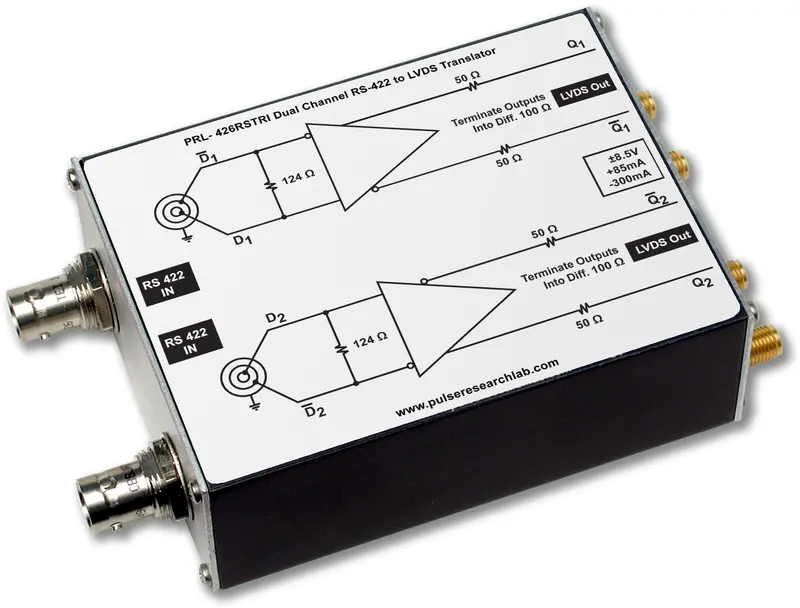
DescriptionThe PRL-426RS is an RS-422-to-LVDS Logic Level Translator. The inputs of the PRL-422RS consist of two pairs of SMA connectors, each internally terminated with 124 Ω between the two signal pins. The SMA shields are tied to chassis ground. They are designed to interface with the 124 Ω differential Serial Data/Data or Clock/Clock outputs from data communications equipment. Model PRL-426RSTRI has Triax input connectors and SMA output connectors. Model PRL-426RSTR has SMA input connectors and Triax output connectors, and is available by special order. The differential outputs are 50 Ω back-terminated and are designed for driving floating 100 Ω loads, normally the configuration used in LVDS input circuits. The output swing is typically 600 mV with a common mode voltage of 1.2 V. These high speed translators facilitate testing of high speed digital communications circuits where conversion of RS-422 clock and data signals to LVDS signals is often required. Each unit is supplied with a ±8.5 V/1.8 A AC/DC Adaptor and housed in a 1.3 x 2.9 x 3.9-in. extruded aluminum enclosure. Available accessories include voltage distribution modules and brackets for mounting multiple units. |
 Fig. 1 PRL-426RS, Dual Channel RS-422 to LVDS Translator, SMA I/Os
 Fig. 2 PRL-426RSTRI, Dual Channel RS-422 to LVDS Translator, Triax Inputs, SMA Outputs
(0° C ≤ TA ≤ 35° C)*
| SYMBOL | PARAMETER | PRL-426RS | UNIT | ||
|---|---|---|---|---|---|
| Min | Typ | Max | |||
| RIN | Input Resistance | 122 | 124 | 126 | Ω |
| RINC | Common Mode Input Resistance | 5k | Ω | ||
| VCM | Input Common Mode Voltage | -2.0 | +3.0 | V | |
| ROUT | Output Resistance | 49.5 | 50.0 | 50.5 | Ω |
| VOL | Output Low Level | 0.9 | V | ||
| VOH | Output High Level | 1.5 | V | ||
| VCMV | Common mode voltage1 | 1.2 | V | ||
| IDC1 | DC Input Current, +8.5 VDC | 85 | 100 | mA | |
| IDC2 | DC Input Current, -8.5 VDC | -265 | -300 | mA | |
| VDC | DC Input Voltage | ±7.5 | ±8.5 | ±12 | V |
| VAC | AC/DC Adapter Input Voltage | 103 | 115 | 127 | V |
| tPLH | Propagation Delay to output ↑ | 2 | ns | ||
| tPHL | Propagation Delay to output ↓ | 2 | ns | ||
| tR/tF | Rise/Fall Times (10%-90%)2 | 1.00 | 1.25 | ns | |
| tSKEW | Skew between any 2 outputs3 | 200 | 500 | ps | |
| fMAX | Max Clock Frequency4 | 500 | 625 | MHz | |
| Size | 1.3 x 2.9 x 3.9 | in. | |||
| Weight, excluding AC adapter | 7 | Oz | |||
| Weight, including AC adapter | 4 | lb. | |||
Notes:
(1) VCMV = (VoH-VoL)/2
(2) Rise and Fall times are measured with SMA output connector units only and with ground-referenced 50 Ω loads.
(3) Skew is measured at the output of a PRL-425N when driven by a PRL-426RS
(4) fmax is measured using a PRL-425N with the corresponding input connectors as the receiver. The NECL outputs of the PRL-425N are measured.
Units with the Trompeter CBBJR79 Triax ouput connectors are tested using the PRL-425NTR, Universal Differential Receiver (Triax) with Differential NECL outputs, and the Trompeter PCGOW10PCG-36 shielded twisted pair cables.
All PRL products with Triax connectors use Trompeter P/N CBBJR79, Right Angle Circuit Board Bulkhead Jack, 3-lug (Numbered page 10, document page 11 of 142). Any Trompeter 70-series Triax Cable Plug with 3 lugs (e.g. PL75-9, 3-lug) will mate with CBBJR79.

While we believe these model to be accurate, no representations are made as to accuracy or suitability for any application:
PRL-426RS:

Explore more from our collection.

Reviews
There are no reviews yet.